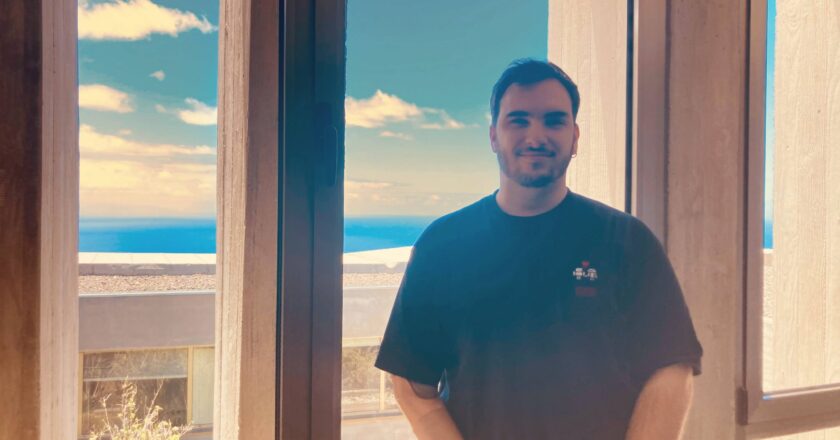
Investigo Program: José Ignacio Capafons Sosa

Juan Ignacio Capafons Sosa, a graduate in Psychology from the University of La Laguna (ULL), completed his Master’s in General Health Psychology and obtained the title of Expert in Third-Generation Contextual Therapies, both also at ULL. He is currently beginning his doctoral thesis.

Regarding the INVESTIGO program, what do you think of these types of initiatives?

I think they are a necessary opportunity for young people interested in research to gain experience in the field and learn from esteemed professionals.

How do you think your participation in the INVESTIGO program will contribute to your long-term professional development?

I believe that participating in this program has significantly boosted my professional career. This type of work experience places me exactly where I want to be and, above all, represents a tremendous help in achieving my long-term goals.

What aspects would you highlight about the contributions you are making to the projects you are working on?

It is impossible for me to answer this question without mentioning my work team. They have consistently included me and prioritized giving me tasks that align with my skills, so I am incredibly grateful to all of them.

What are the main challenges you have faced as a participant in this program, and how have you overcome them?

In my opinion, entering the world of evaluation and research for the first time is a significant challenge. The internal workings of research networks are much more complex than they might initially appear. Another challenging task is gaining self-confidence when performing certain activities independently, especially when you are surrounded by people you admire for their competence.

How has your experience been working at SESCS? How would you describe the work environment, and what do you think about the organizational aspect?

I believe working at SESCS has been a much greater opportunity than I could have ever imagined. In just a few months, I feel that I have learned more than I did in years of training. My colleagues have been constantly supportive in helping me adapt, and I have felt very welcomed from day one. Being surrounded by such special people, both in their work and outside of it, can only help propel my professional career to places I never thought possible. Therefore, I can only feel gratitude for being here.


Investigo Program: Lena Arnal Artiaga

Lena Arnal Artiaga, a graduate in Psychology from the University of Granada (UGR), always knew she was interested in clinical psychology and social intervention. Therefore, she pursued a Master’s degree in General Health Psychology, also at UGR. Throughout her training, she dismissed the possibility of working in research, feeling it was an almost impossible path. Thanks to this opportunity, she is challenging her preconceived ideas, opening new doors, and learning new skills.

Regarding the INVESTIGO program, what do you think of these types of initiatives?

I believe it is a great opportunity to introduce young people to the world of research, which is often seen as a difficult field to break into (at least that has been my impression throughout my training).

How do you think your participation in the INVESTIGO program will contribute to your long-term professional development?

Simply being in contact with so many professionals from different fields makes this experience very enriching. In my case, I am exposed to areas of knowledge in which I have little prior experience, so I am discovering new paths and interests as a psychologist.

What aspects would you highlight about the contributions you are making to the projects you are working on?

On one hand, my role involves supporting different projects, which I believe is important and necessary work as it helps free up the schedules of other professionals working on multiple projects at SESCS. On the other hand, in the projects where I am more actively involved, I try to bring enthusiasm, new ideas, and apply everything I have learned during my years of training as a psychologist.

What are the main challenges you have faced as a participant in this program, and how have you overcome them?

As I mentioned before, research is quite a new area for me, so everything I am encountering at SESCS is new and, therefore, challenging. I find my work on the qualitative aspects of the projects challenging since my training has always been linked to the quantitative method. Additionally, understanding the procedures and ways of working at SESCS is entirely new to me, so learning how it operates and the steps needed to carry out a research project has also been a challenge.

How has your experience been working at SESCS? How would you describe the work environment, and what do you think about the organizational aspect?

From the very beginning, we were welcomed with open arms, so my experience at SESCS has been quite positive, though I find the most support comes from my fellow “investigo” colleagues.

Investigo Program: Alejandra Abrante Luis

Alejandra Abrante Luis completed her Bachelor’s degree in Psychology at the University of La Laguna in 2021, followed by a Master’s degree in General Health Psychology at the European University of the Canary Islands in 2023. She also participated in two courses offered by the General Foundation of the University of La Laguna: “Evaluation and Treatment of Childhood and Adolescent Depression” in 2020, and “Psychosocial Intervention in Sexual and Gender Diversity” in 2021.

Regarding the INVESTIGO program, what do you think of these types of initiatives?

I believe they provide a great opportunity for people who want to train in research and have no prior experience.

How do you think your participation in the INVESTIGO program will contribute to your long-term professional development?

I think it will contribute positively, as I want to pursue a PhD in my field. Therefore, all the knowledge gained in the program will be very helpful to me.

What aspects would you highlight about the contributions you are making to the projects you are working on?

I think a positive aspect is that I had previously conducted a systematic review and had some knowledge, so it wasn’t a completely new beginning, which I believe eases the workload of my group. On the other hand, my enthusiasm for learning and engaging in various activities in the service motivates me to pursue self-learning and try to perform all the tasks proposed to me in the best possible way.

What are the main challenges you have faced as a participant in this program, and how have you overcome them?

Some of the challenges have been learning to use new programs for conducting meta-analyses or specific training on aspects related to scientific evidence and systematic reviews. However, with the help of my colleagues in the service or through training videos, I have been learning everything without difficulty.

How has your experience been working at SESCS? How would you describe the work environment, and what do you think about the organizational aspect?

The experience has been very satisfying. The environment is very good, both generally and within my own workgroup, and on an organizational level, it seems that the work plan is quite structured. In fact, even if new work requests arise, they are quickly organized, which demonstrates the flexibility of the service and its employees.